60+ EU Civil Society Organisations and NHRIs Calls on the Cypriot Presidency of the Council of the EU to Act on European Courts Judgments Enforcement
/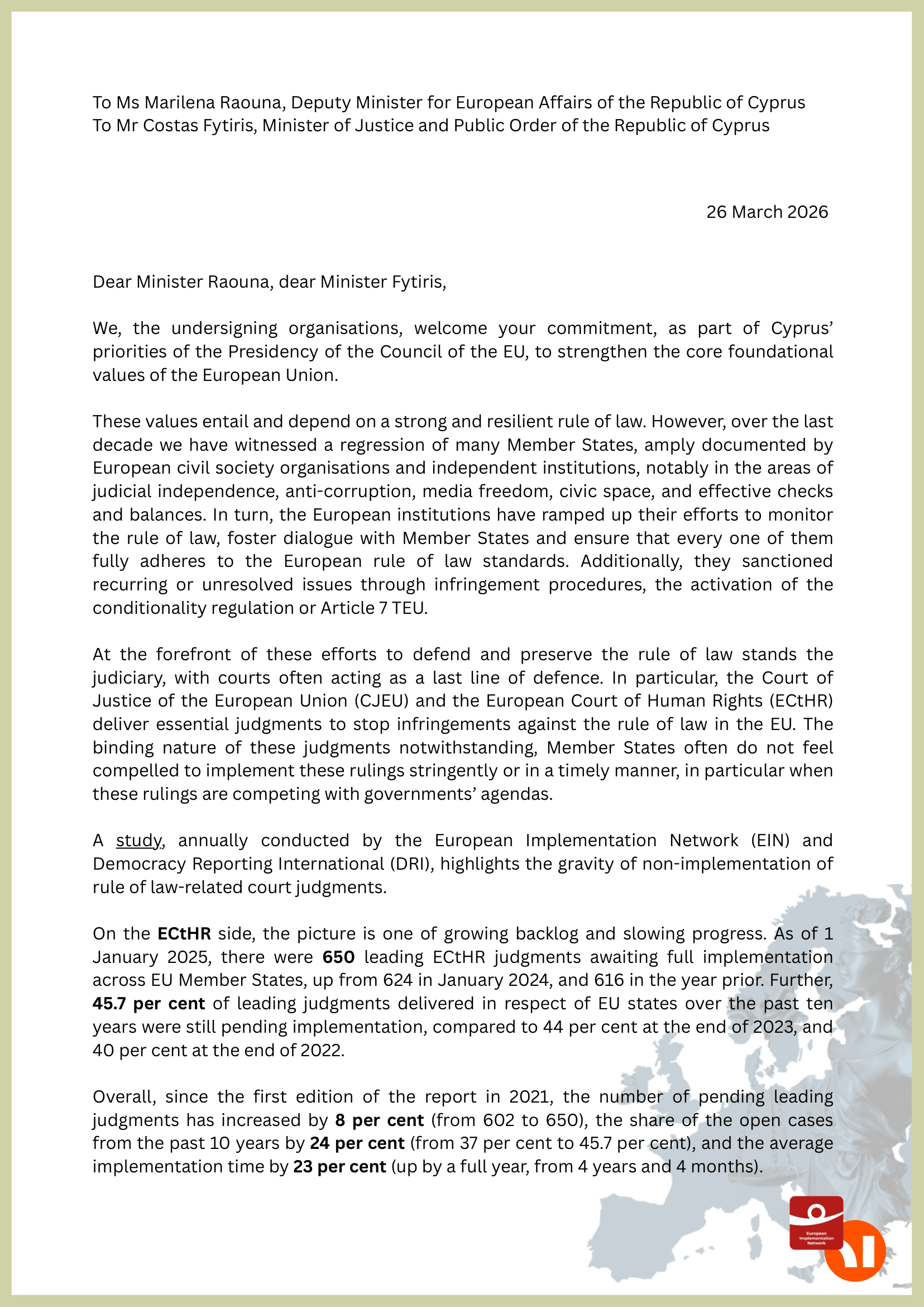
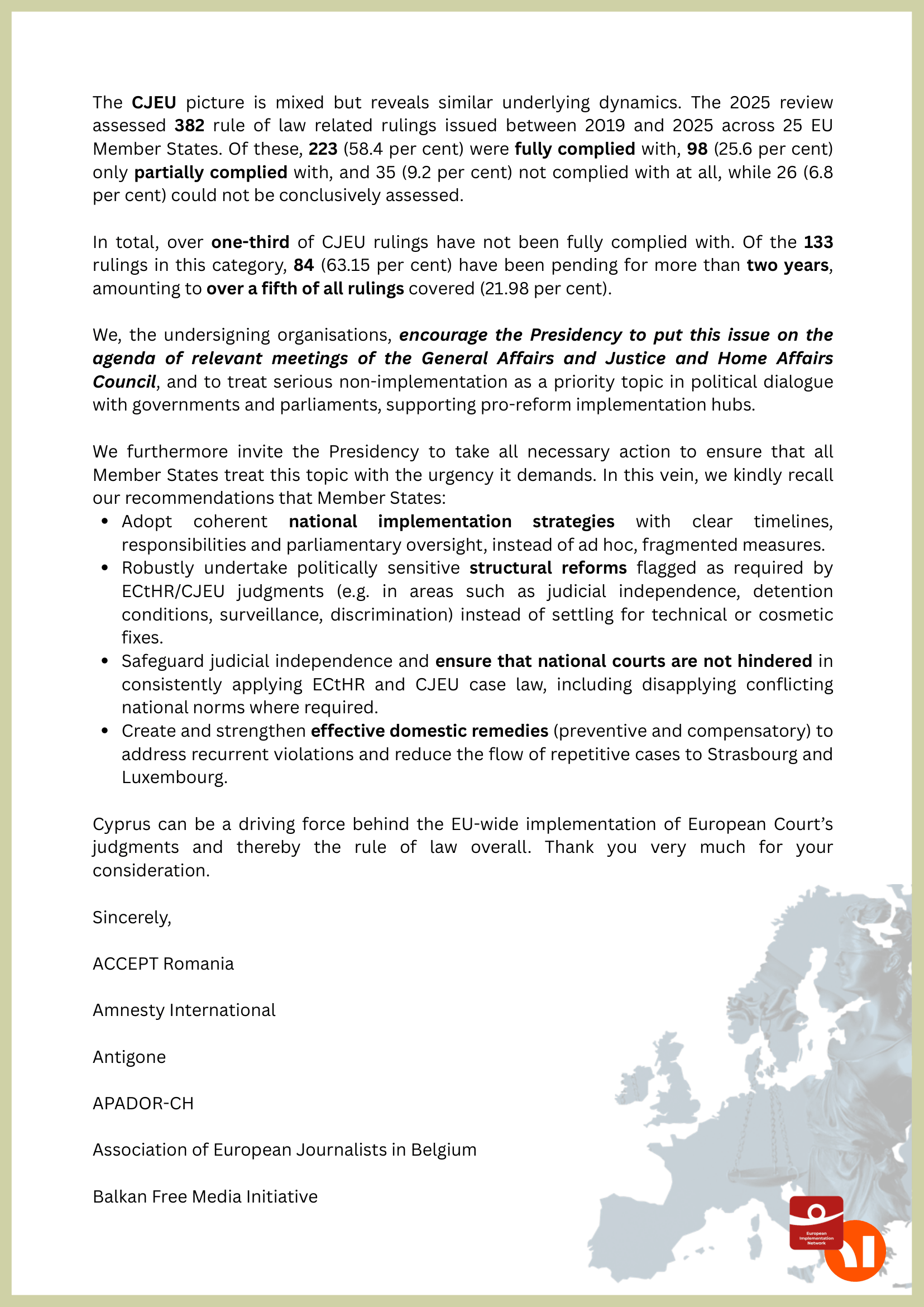
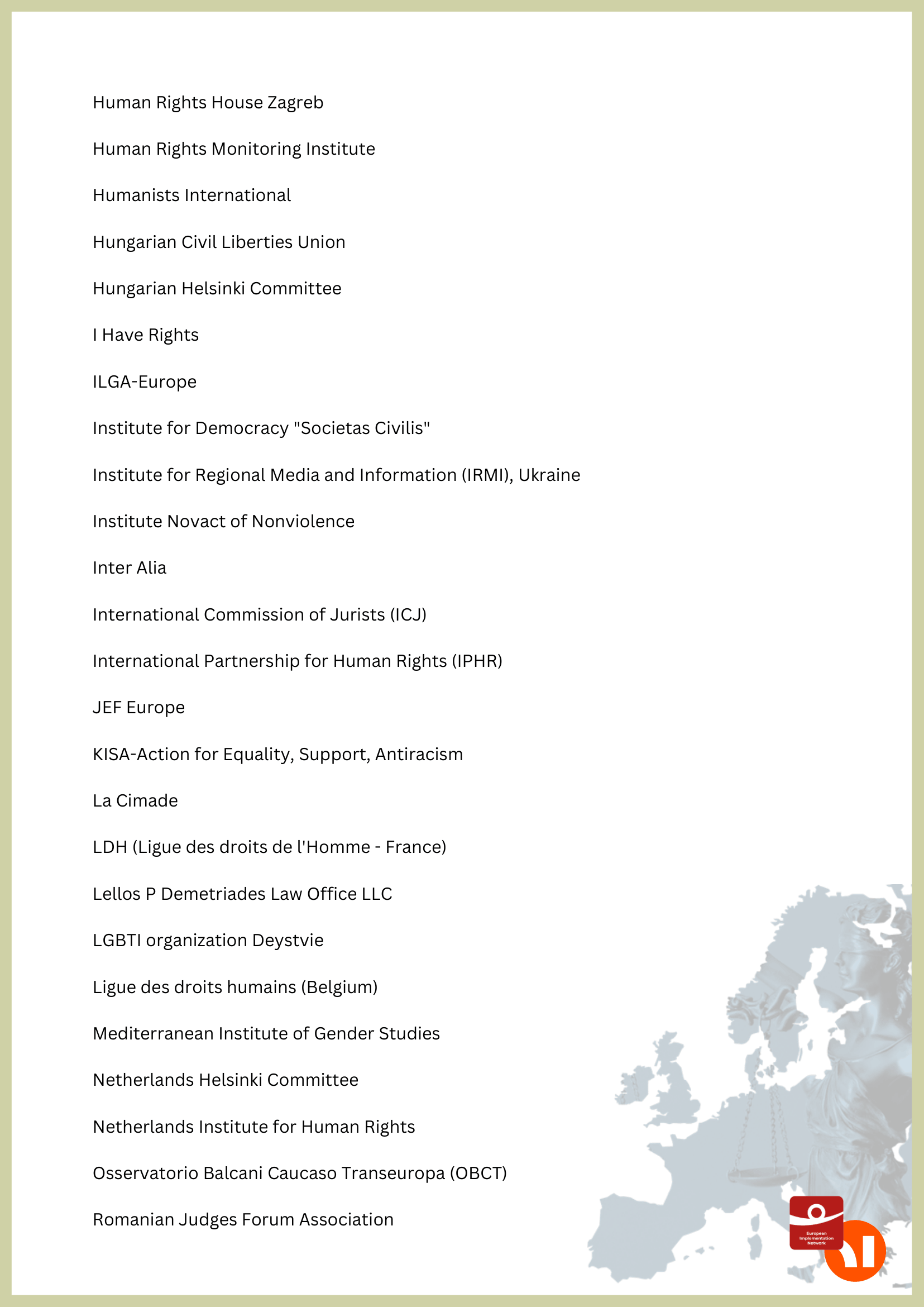
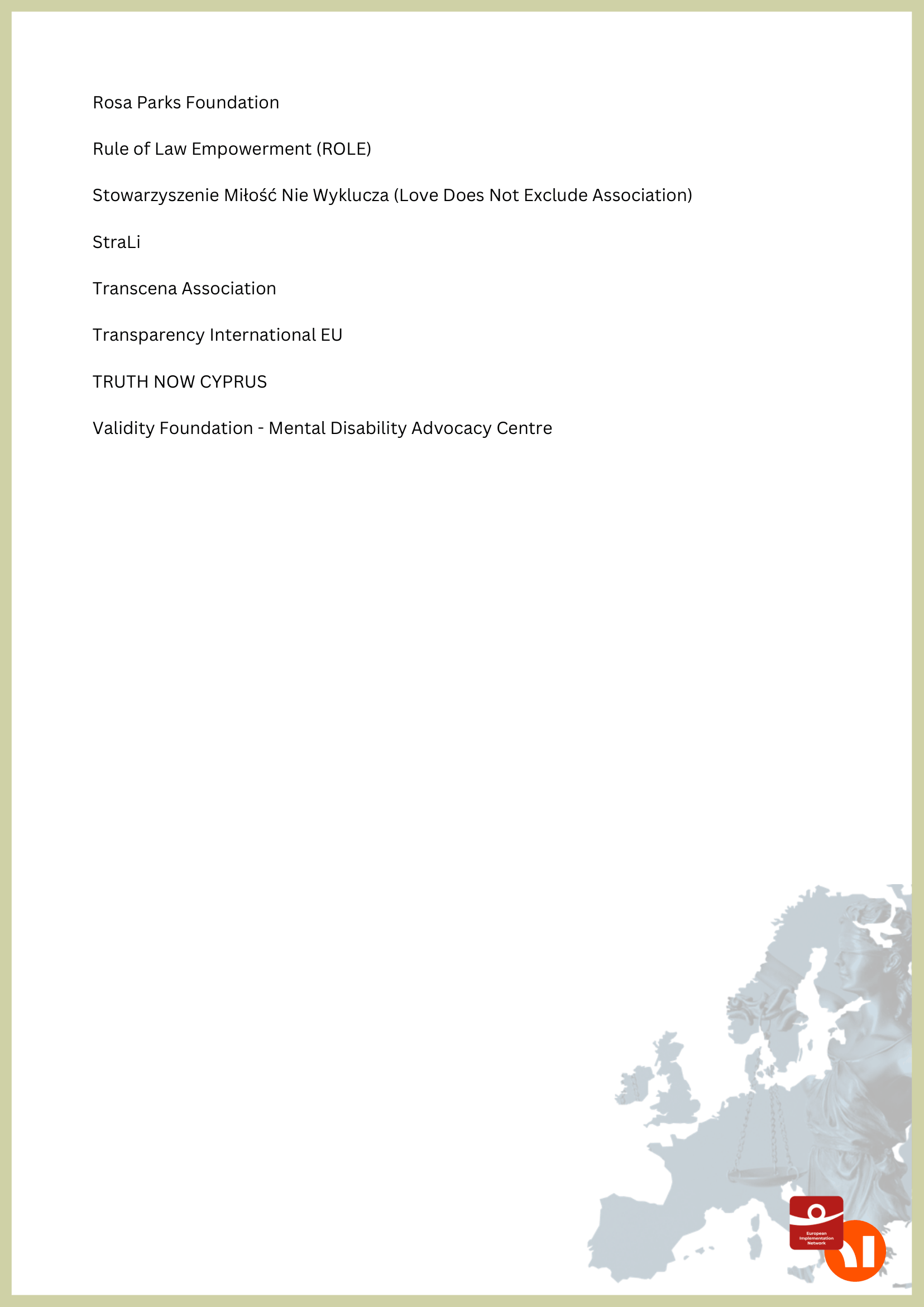
On 26 March 2026, a broad coalition of 63 civil society organisations and NHRIs addressed a joint letter to the Cypriot Presidency of the Council of the EU, urging renewed political commitment to one of the European Union’s most fundamental pillars: the rule of law.
At a time when the EU continues to reaffirm its foundational values, the letter highlights a critical — and often overlooked — gap between commitment and reality which lies with the persistent failure of Member States to fully implement judgments from the Court of Justice of the European Union and the European Court of Human Rights.
A growing implementation crisis
While both courts play a central role in safeguarding rights and upholding legal standards across Europe, their authority ultimately depends on national compliance. Here, the data paints a concerning picture.
Across EU Member States, nearly half of leading ECtHR judgments from the past decade remain unimplemented. The backlog continues to grow, and implementation timelines are steadily increasing. Similarly, more than one-third of relevant CJEU rulings have not been fully complied with, with many cases lingering unresolved for years.
These trends are not merely technical shortcomings, they point to deeper structural and political challenges. In many instances, governments delay or resist implementation when rulings require politically sensitive reforms, particularly in areas such as judicial independence, media freedom, or anti-corruption.
Courts as a last line of defence
In this context, European courts increasingly act as a last line of defence against rule of law backsliding. Yet their effectiveness is undermined when judgments are only partially implemented, or ignored altogether.
The letter therefore calls on the Cypriot Presidency to elevate the issue of non-implementation within EU political dialogue, including discussions in the General Affairs and Justice and Home Affairs Councils. It also urges Member States to move beyond ad hoc responses and adopt structured and accountable implementation strategies.
From commitments to action
The recommendations put forward are clear:
Adopt coherent national implementation strategies with clear timelines, responsibilities and parliamentary oversight, instead of ad hoc, fragmented measures.
Robustly undertake politically sensitive structural reforms flagged as required by ECtHR/CJEU judgments (e.g. in areas such as judicial independence, detention conditions, surveillance, discrimination) instead of settling for technical or cosmetic fixes.
Safeguard judicial independence and ensure that national courts are not hindered in consistently applying ECtHR and CJEU case law, including disapplying conflicting national norms where required.
Create and strengthen effective domestic remedies (preventive and compensatory) to address recurrent violations and reduce the flow of repetitive cases to Strasbourg and Luxembourg.
As Cyprus takes on the Presidency, it has an opportunity to drive forward a more consistent and credible approach to enforcing European court judgments.
Ultimately, the rule of law in the EU is not only defined by the quality of its legal standards, but by the willingness of its Member States to uphold them in practice.
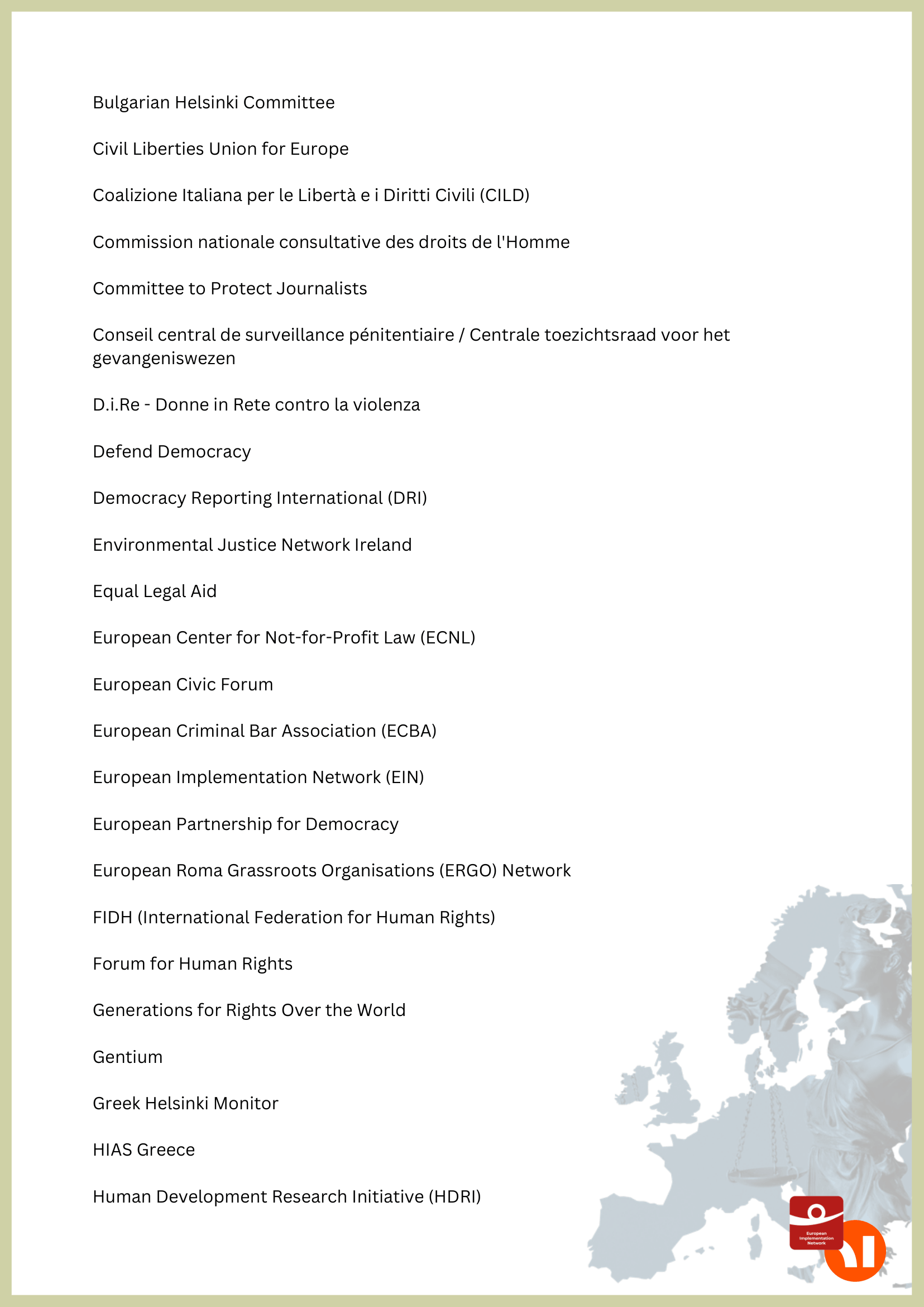
Signatories:
ACCEPT Romania
Amnesty International
Antigone
Association for the Defence of Human Rights in Romania (APADOR-CH)
Association of European Journalists in Belgium
Balkan Free Media Initiative
Bulgarian Helsinki Committee (BHC)
Civil Liberties Union for Europe
Coalizione Italiana per le Libertà e i Diritti Civili (CILD)
Commission nationale consultative des droits de l'Homme (CNCDH)
Committee to Protect Journalists (CPJ)
Conseil central de surveillance pénitentiaire / Centrale toezichtsraad voor het gevangeniswezen
D.i.Re - Donne in Rete contro la violenza
Defend Democracy
Democracy Reporting International (DRI)
Environmental Justice Network Ireland
Equal Legal Aid
European Center for Not-for-Profit Law (ECNL)
European Civic Forum
European Criminal Bar Association (ECBA)
European Implementation Network (EIN)
European Partnership for Democracy (EPD)
European Roma Grassroots Organisations (ERGO) Network
International Federation for Human Rights (FIDH)
Forum for Human Rights
Generations for Rights Over the World (GROW)
Gentium
Greek Helsinki Monitor (GHM)
HIAS Greece
Human Development Research Initiative (HDRI)
Human Rights House Zagreb (HRHZ)
Human Rights Monitoring Institute (HMRI)
Humanists International
Hungarian Civil Liberties Union (HCLU)
Hungarian Helsinki Committee (HHC)
I Have Rights
ILGA-Europe
Institute for Democracy "Societas Civilis"
Institute for Regional Media and Information (IRMI - Ukraine)
Institute Novact of Nonviolence
Inter Alia
International Commission of Jurists (ICJ)
International Partnership for Human Rights (IPHR)
JEF Europe
KISA-Action for Equality, Support, Antiracism
La Cimade
Ligue des droits de l'Homme (LDH - France)
Lellos P Demetriades Law Office LLC
LGBTI organization Deystvie
Ligue des droits humains (Belgium)
Mediterranean Institute of Gender Studies
Netherlands Helsinki Committee (NHC)
Netherlands Institute for Human Rights
Osservatorio Balcani Caucaso Transeuropa (OBCT)
Romanian Judges Forum Association
Rosa Parks Foundation
Rule of Law Empowerment (ROLE)
Stowarzyszenie Miłość Nie Wyklucza (Love Does Not Exclude Association)
StraLi for Strategic Litigation
Transcena Association
Transparency International EU
TRUTH NOW CYPRUS
Validity Foundation - Mental Disability Advocacy Centre