
Rule of Law crisis: EU Parliament calls on the Commission and member states to take action without further delay
/
Hemicycle of the European Parliament, Strasbourg, 2014. Photo licensed under licence CC BY-SA 3.0
On 29 April 2026, the European Parliament adopted its response to the European Commission's 2025 Rule of Law Report, sending a clear and broadly-supported message — with 387 votes in favour, 191 against, 46 abstentions — that the European Union can no longer afford to treat rule of law compliance as a bureaucratic requirement with no real-world consequences. The European Implementation Network (EIN) welcomes this vote which represents an institutional echo of a principled stance EIN has been advancing for years. EIN insists that the EU Parliament’s resolution is properly taken by the Commission and member states and followed by concrete measures in Brussels and at the national level.
What does the resolution say
One number from the Liberties Rule of Law report 2025, as emphasized in the EU parliament’s text, says it all: 93% of the European Commission rule of law’s recommendations are simply repeated from prior years. In other words, member states do not comply with their obligations, notably in the field of judicial independence, anti-corruption, media freedom, civic space, and fundamental rights, areas which remain under threat across the Union. In this respect, the Parliament asked the Commission to treat prison conditions as a rule of law concern in its own right.
“since 2022, about one third of all Member States have shown little or no progress in implementing the Commission’s recommendations; whereas nine countries consistently have five to eight recommendations that remain unimplemented; whereas 61 % of the recommendations assessed in 2025 have shown little or no progress since 2022; whereas 93 % of all the Commission’s 2025 recommendations are repetitions from previous years (with 71 % dating back to 2022) and only nine new recommendations were introduced in 2025; whereas in 2025, only 6 % of recommendations could be considered fully implemented”
Against this concerning dynamic, and while the Commission's annual monitoring process continues to under-report serious structural vulnerabilities, the Parliament renewed its call to member states to take effective actions to address systemic rule of law issues and enforce rulings from both the Court of Justice of the EU and the European Court of Human Rights. It also pressed the Commission to use enforcement tools more decisively in cases of persistent non-implementation, including infringement proceedings, Article 260 TFEU follow-up actions, and, where relevant, budgetary conditionality.
“Asks the Commission to strengthen the follow-up mechanism for non-implemented recommendations by introducing measurable benchmarks, [...] calls for the use of all available enforcement tools to be strengthened, where appropriate, including infringement proceedings and budget conditionality, as provided for by the Financial Regulation, Rule of Law Conditionality Regulation and Common Provisions Regulation; calls on the Commission to systemically resort to expedited procedures and applications for interim measures before the CJEU in infringement cases, and to trigger actions regarding the nonimplementation of the CJEU’s judgments; notes with concern that in the most recent report only two Member States received an additional recommendation compared with the previous reporting cycle, despite the fact that the rule-of-law situation in several Member States warrants urgent action and in others Member States requires recommendations to be implemented urgently”
Why does it matter for EIN
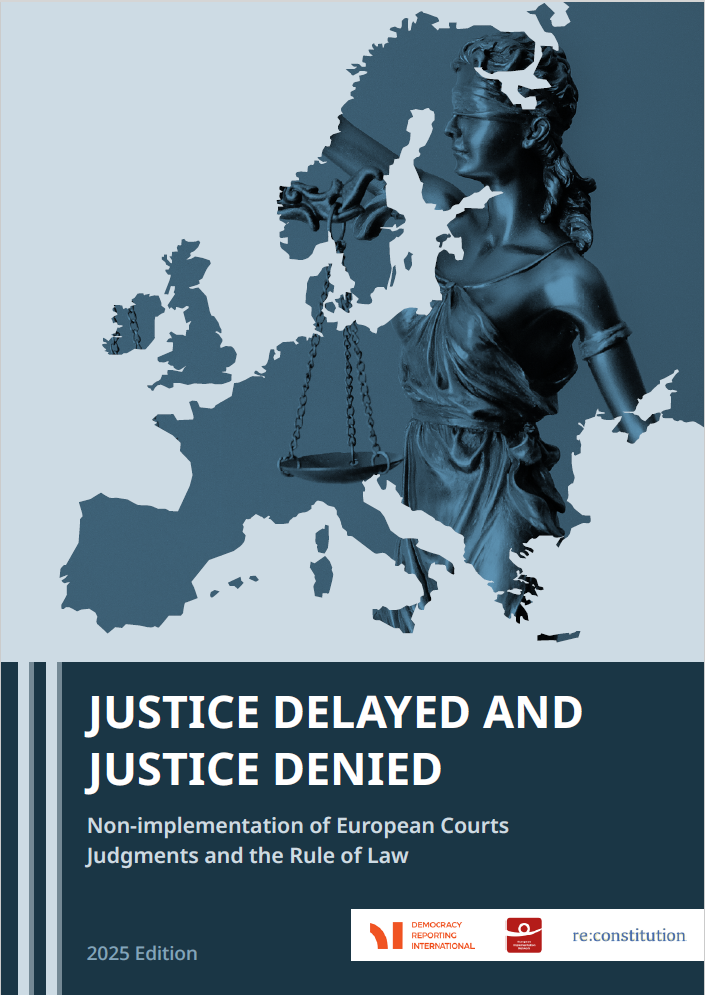
This is at the core of what EIN, together with its partner Democracy Reporting International, has been documenting and advocating for across four editions of our report ‘Justice Delayed and Justice Denied: Report on the Non-implementation of European Judgments and the Rule of Law’. The data from our most recent 2025 edition1 shows the scale of the problem: 650 leading ECtHR judgments remain unimplemented across EU member states, which on average have been pending implementation for five years and four months, with nearly half (45.7%) of leading judgments delivered against EU states over the past decade remaining pending. 5 years and 4 months, during which the problems identified by the Court continue at least to be partially unimplemented, leaving the affected individuals and communities without full redress, and failing to guarantee effective enjoyment of relevant rights in accordance with the Convention standards to all the other people across the EU. On the CJEU side, over a third of rule of law rulings have not been fully complied with, and nearly two-thirds of those have been pending for more than two years. Beyond their immediate human cost, failures or delays in translating judicial decisions into effective rights protection in a timely manner have far-reaching societal implications, most notably the erosion of public trust in institutions, the weakening of the rule of law and, when left unaddressed, the gradual hollow out of democratic governance.
Since 2022, following sustained calls from EIN, the European Commission integrated ECtHR implementation data into its annual Rule of Law Report. That was a hard-won step which allowed the EU's rule of law monitoring mechanism to see patterns in non-compliance that had previously been invisible. Yet the inclusion of this data, however important and welcome, remains meaningless without decisive follow-up. What is needed is greater political will from member states, and a firmer commitment from the Commission to act when action is required and use all of the instruments at its disposal to respond to rule of law challenges, because this is exactly where the strength of the rule of law monitoring mechanism lies. In addition, while ECtHR implementation data keeps being taken into account within the Commission’s assessment, its report continues to fail to integrate data concerning (non-) compliance with CJEU rulings, which provide a complementary view of the non-implementation rule of law patterns in EU Member States.
The Parliament's resolution makes it unequivocally clear that the Commission can no longer turn a blind eye to the failure of certain member states to uphold the rule of law. In addition, EIN welcomes the Parliament’s call for prison conditions to be treated as a rule of law concern in its own right. In fact, prison conditions is an area where ECtHR judgments have accumulated for decades in several EU countries, diagnosing complex and systemic problems, where EIN documented persistent non-compliance, and where the practical human cost of inaction is measured not in abstract institutional terms but in the daily lives of thousands of people held in inhuman and degrading conditions flawed by overcrowding, lack of hygiene and other basic human needs.
What needs to happen now
The European Parliament's April 2026 resolution is one of the strongest signals to date from an EU institution that the failure to implement European court judgments, and the failure to follow up on rule of law recommendations, is not acceptable and must carry consequences. The fact that 93% of Commission recommendations are repeated year after year is evidence that the monitoring cycle, on its own, does not generate the change it intends to. It is now for the European Commission to act on it, not by writing another set of recommendations that will be repeated in this year’s edition of the Rule of Law Report and the next, but by using the tools at its disposal with real decisiveness.
For EIN, the asks remain what they have been in successive editions of Justice Delayed and Justice Denied.
The Commission, and other EU institutions where relevant, should:
Make implementation of CJEU judgments, in the same way as the ECtHR judgments, a core metric in the Rule of Law Report, with systematic use of implementation data and clear country comparisons.
Systematically issue tailored country-specific recommendations based on ECtHR/CJEU implementation records, with particular focus on chronic underperformers (especially Bulgaria, Hungary, Poland and Romania).
Develop a public scoreboard or equivalent tool tracking national follow-up to ECtHR and CJEU case law (including preliminary rulings).
Use enforcement tools more decisively in cases of persistent non-implementation (infringements, follow-up under Article 260 TFEU, and, where relevant, budgetary conditionality).
Treat serious non-implementation as a priority topic in political dialogue with governments and parliaments, supporting pro-reform “compliance communities”.
Create or adapt EU funding lines specifically to support implementation-oriented work by civil society, legal professionals and oversight bodies.
Turning to member states, our ask is equally clear:
Adopt coherent national implementation strategies with clear timelines, responsibilities and parliamentary oversight, instead of ad hoc, fragmented measures.
Robustly undertake politically sensitive structural reforms flagged as required by ECtHR/CJEU judgments (e.g. in areas such as judicial independence, detention conditions, surveillance, discrimination) instead of settling for technical or cosmetic fixes.
Safeguard judicial independence and ensure that national courts are not hindered in consistently applying ECtHR and CJEU case law, including disapplying conflicting national norms where required.
Create and strengthen effective domestic remedies (preventive and compensatory) to address recurrent violations and reduce the flow of repetitive cases to Strasbourg and Luxembourg.
Legal victories in Strasbourg and Luxembourg are not translating into real change fast enough for the people they are supposed to protect. The Parliament has once again said this clear message. It should not dissipate into institutional silence, but compell action at the Commission and, ultimately, within member states themselves.