Council of Europe SOGIESC Unit and EIN Joint Thematic Briefing Session to the Permanent Representations to the Council of Europe ahead of the 1569th CM/DH meeting (15-17 September)
/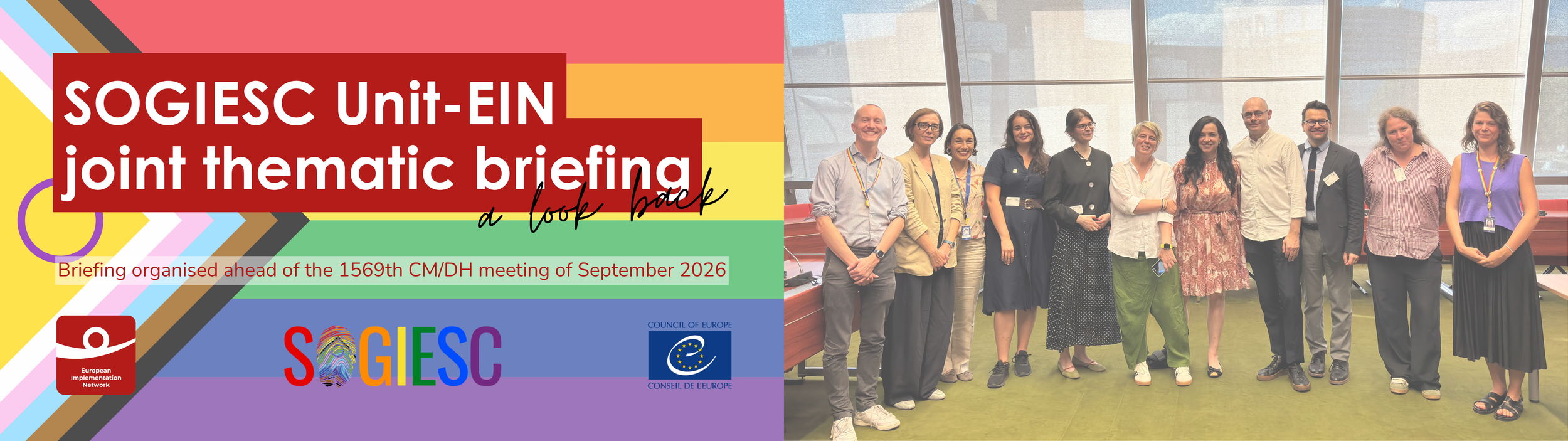
On September 4th, 2026, EIN jointly with the Council of Europe’s Sexual Orientation, Gender Identity and Expression, and Sex Characteristics (SOGIESC) Unit organised in Strasbourg a thematic briefing session for the Permanent Representations to the Council of Europe ahead of the 1569th Committee of Ministers Human Rights Meeting, scheduled for 15th-17th September 2026. The briefing focused on a number of ECtHR cases concerning three main SOGIESC thematic issues:
Registered partnerships and legal recognition of same-sex couples (Buhuceanu and Others v. Romania, Koilova and Babulkova v. Bulgaria, Przybyszewska and Others v. Poland group);
Legal gender recognition (A.D. and Others v. Georgia, Rana v. Hungary group, X. v. the former Yugoslav Republic of Macedonia);
Hate crime and freedom of assembly (Identoba and Others v. Georgia group, M.C. and A.C. v. Romania, Association ACCEPT and Others v. Romania).
Participants discussed recent developments, common challenges, and remaining implementation gaps, highlighting persistent legislative and practical barriers as well as country-specific concerns that hinder the full, effective and timely execution of the Court’s judgments.
Registered partnerships and legal recognition of same-sex couples
Across Bulgaria, Poland and Romania, implementation of ECtHR judgments concerning the legal recognition of same-sex couples has been meeting similar obstacles. Governments continue treating reform as conditional on socio-political consensus, even though public acceptance of the matter keeps growing in all three countries, and the Court's own standards leave little room for a consensus-based argument. Institutional inaction also often persists, with periods of political instability invoked to justify postponing the preparatory work for reform. Finally, domestic courts show a track record of often relying on constitutional provisions, ordinary family law or public-order reasoning to withhold effect from unions the Court has already found deserving of protection, making too little use of the non-legislative interim steps that could shield couples in the meantime. The result is that litigation keeps substituting for the structural reform the judgments call for, and that the gap between European standards and domestic practice keeps widening, a divergence the Court of Justice of the European Union has now sharpened through its ruling of 25 November 2025 in Wojewoda Mazowiecki (C-713/23), which requires EU member states to recognise a same-sex marriage lawfully concluded in another member state.
Legal gender recognition
Georgia, Hungary and North Macedonia are all bound by the same general obligation under Article 8, to provide a quick, transparent and accessible procedure for legal gender recognition. Nonetheless, across all three, legislative gaps persist or have reopened, the law, where it exists, is imprecise enough to leave officials discretion, and in the absence of clear rules any interim administrative practice stays vulnerable to reversal. Civil society notably reported that trans people and the specialised organisations that work with them are rarely brought into the consultation processes meant to address this reflecting an absence of political will to address the root causes of the problem. More recently civil society has underscored that the pattern has shifted from stagnation to active regression, with previously available administrative avenues restricted or withdrawn, new legislative or constitutional barriers introduced, and intolerance-driven policy leaving individual applicants without an effective remedy even where the Court has already ruled in their favour. In the wider region, thirteen legal gender recognition cases from seven countries are currently pending implementation before the Committee of Ministers, some dating back to 2008, and not one respondent state has yet built a durable legal framework. Public authorities are the main obstacle, often failing to implement human rights obligations for reasons ranging from a lack of knowledge, indifference, or hostility, and reinforced by weak political international peer-pressure. As domestic courts are forced to fill the gap, costly legal pathways emerge, while a growing “pick and choose” approach risks undermining the broader authority of the ECHR system.
Hate crime and freedom of assembly
In Georgia and Romania, the authorities continue to adopt a non-Convention compliance stance, treating LGBTI freedom of assembly as a risk to be managed, leading to investigations into violence against participants to marches and events, as well as human rights defenders, to remain ineffective and left to run until the limitation period closes them. Authorities report important training numbers to the Committee of Ministers, but their effect on real cases is minimal as no curriculum or evaluation show what actually changed in practice, and the training is not reinforced by any zero-tolerance message from the highest levels of government. In this context, civil society carries out the execution work, while also facing numerous operational obstacles, including funding and security pressure.
Recommendations
Among other recommendations that were formulated, civil society experts asked the Committee of Ministers to:
Use formal opportunities of monitoring process as much as possible to:
Keep cases on enhanced supervision, review regularly/ often;
Require concrete, time-bound and measurable results, in relation to all actions needed;
Consider to include pending ECtHR cases with similar problems as evidence base for implementation process;
Bring out interim resolutions;
Consider sending cases back to the ECtHR
Require the removal of legislative bans and the prevention of new barriers;
Require that all necessary measures are taken to protect applicants with pending applications;
Use a ’sticks & carrot’ approach: technical support by the CoE SOGIESC Unit, insist on CSO involvement.
Ensure meaningful participation of the LGBTI community and specialised NGOs in the deliberations for the necessary reforms concerning SOGIESC matters, and in particular of the trans community concerning legal gender recognition;
Respond firmly to persistent non-execution, exercising political pressure from CoE and peer member States and addressing non-implementation as unacceptable wherever possible, framing it as a rule of law problem.
For more details on the latest developments in these cases and civil society’s recommendations for their implementation, refer to the presentation, and the respective Rule 9.2 communication submitted ahead of the September 2026 CM/DH:
Registered partnerships and legal recognition of same-sex couples
Legal gender recognition cases
Hate crime and freedom of assembly